A recent paper by Lewis and Kessler, (Reference 1), has highlighted the fact that regions of the near Earth environment may already be above the spatial density threshold at which a collisional cascade takes place. An even broader range of orbital altitudes was found to exceed the ‘unstable’ threshold, suggesting that a large proportion of low Earth orbit (LEO) may have limited capacity to absorb further satellite population growth or major fragmentation events.
In the light of this warning, it is to be hoped that a debate on establishing numerical limits for the total LEO population, (the LEO “carrying capacity”, as learned commentators such as Moriba Jah have described it), will now take place.
These population limits should include margins to allow for a number of different factors that are described below, including population and tracking uncertainties; possible major collisions; and variations in the LEO space environment itself.
Collision probability
Establishing the true collision risk in LEO is problematic. It is generally accepted that objects around 1cm in size, travelling at orbital velocity, have enough kinetic energy to disable an operational satellite and potentially cause a catastrophic breakup. It is also widely acknowledged that the current tracking systems that contribute to the maintenance of the orbital catalogue are limited to objects around10cm in size and larger.
Estimates of the population of objects in the “lethal non-trackable”, (LNT), size range between 1-10cm vary considerably – NASA’s estimate is around 500,000, whereas the ESA fragmentation model currently places the total at around 1.3 million. There is clearly a need for greater data sharing and standardisation.
If for no other reason, this uncertainty in the orbital population is a reason for including margins in any limits placed on the orbital population.
The potential for unfortunate space weather events
The potential for catastrophic collisions between objects in LEO has been a source of concern for many decades, but recent analyses highlight the problems more clearly.
A “crash clock”, (Reference 2), has been developed to estimate how long it would take for a collision to occur after a space weather event, and suggests that the time window to recover control following a solar storm has narrowed significantly in the mega-constellation era. Although alarming, this estimate is nevertheless “optimistic”, in the sense that it assumes only that the operational satellites cease to perform collision avoidance manoeuvres as a result of the significant space weather event.
In reality, the situation is more serious than this. A major solar storm’s effects on the upper atmosphere are expected to include an increase in the drag on all objects in low Earth orbit, with the result that their positions will be subject to much greater uncertainties. This effect was seen during a solar storm in 1989, and although the time needed to restore “custody” of the catalogue is debated, it was certainly much longer than the collision-time estimates produced by the “crash clock”; (with some well-placed commentators suggesting that it took an entire year to return the catalogue to its former levels of accuracy). It should also be noted that space weather has the potential to degrade the tracking accuracy of radar sensors, via the process of scintillation in the atmosphere. So, just as the objects in Earth orbit are starting to change orbits in unexpected ways, our ability to monitor those changes is also degrading. This is not a happy scenario.
It should be noted that the space weather event in 1989 was comparatively minor compared with some in the historical record. The much larger Carrington event from 1859 is often cited as the “design threshold” for space systems, (although our understanding of its potential effects on satellite hardware is only partial, and based on modelling, since clearly there were no man-made objects in Earth orbit when it happened). However, even this huge event is dwarfed by a solar eruption dated to 774 A.D., which is estimated to be 10 times more powerful.
This is another strong argument for appropriate margins on the orbital population.
The potential for especially bad collisions
Collisions between satellites with masses of a tonne or two are clearly bad news, but there are some large debris impact scenarios that are even worse. This is because there can be significantly more mass involved, and because there is very little prospect that these encounters can be prevented, since there is currently no mechanism for collision avoidance manoeuvres. The situation might improve in the future if “space tugs” become a reality, but at present these missions are largely on the drawing board, and the fact that many debris objects tumble makes successful capture and manoeuvring a challenging operation
McKnight and Maclay (Reference 3) have noted that if two of the larger debris objects in LEO were to collide, (e.g. a pair of 9-tonne Russian rocket bodies), then “the catalog population could double in an instant with the liberation of roughly 16,000 trackable fragments and 200,000 or more LNT”. Whilst it is acknowledged that these fragments might be created “in an instant”, the capacity of the tracking network suggests that it would take much, much longer than this for the pieces to find their way into the catalog. (As a comparator, it took approximately three and a half years to catalogue the three and a half thousand objects created by the Chinese ASAT test in 2007).
Their analysis suggests that our safety margins need to be large.
LEO is not a closed system
There is, however, a further potential hazard scenario that has previously received little attention, but which also has the potential to tip the population in LEO into a runaway scenario. This is the possibility of an extreme meteor shower.
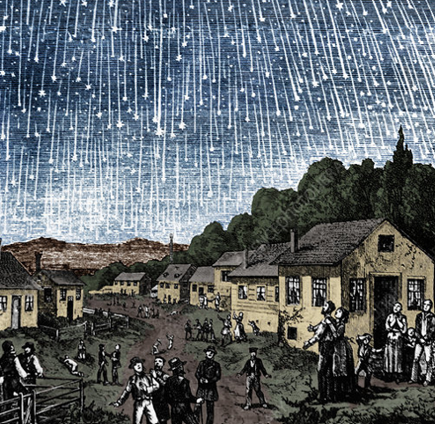
The illustration below shows a contemporary illustration of the Leonid meteor shower that occurred in 1833. Over a nine-hour period, (on 12 and 13 November of that year), the Leonid stream produced an estimated 50,000 to 150,000 meteors per hour.
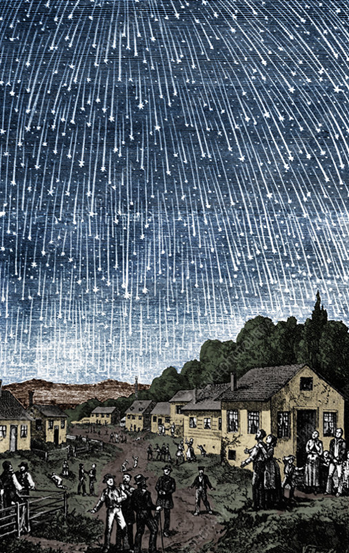
The Leonid Meteor Shower of 1833
At the time, clearly, there were no satellites in orbit, but if a comparable event were to happen today, it is likely that not only would some of the on-orbit hardware be badly damaged, but also that our tracking systems (both optical and radar), would be compromised for many hours, resulting in a loss of custody for many of the objects in orbit. Optical tracking would clearly have a hard time differentiating satellite trails from the intense meteor flux, and the plasma generated in meteor trails is well known to affect the propagation of radar signals.
It is sobering to reflect on the potential degradation to the catalogue that might result if we were unable to track effectively for a number of hours, during which several new clouds of debris were created.
Clearly, we would be hugely unfortunate if all the negative scenarios listed above were to come to pass in the near future – the probability that a major in-orbit collision is rapidly followed by a huge solar event and a massive meteor storm is vanishingly small. But the probability that one of these catastrophes might occur is definitely not zero, and we should plan for some “headroom” in the orbital population.
We need to evaluate the uncertainties and agree those safety margins…..and soon.
Reference 1: CRITICAL NUMBER OF SPACECRAFT IN LOW EARTH ORBIT: A NEW ASSESSMENT OF THE STABILITY OF THE ORBITAL DEBRIS ENVIRONMENT Hugh G. Lewis and Donald J. Kessler; SDC9-paper305
Reference 2: A new CRASH clock measures the chance of satellite collisions, and it’s ticking down fast
Reference 3: Space Environment Management: A Common Sense Framework for Controlling Orbital Debris Risk. Dr. Darren McKnight; Dr. Timothy Maclay. AMOS conference paper.
